
Sorry for the delay but I’ve had a lot going on in real life.
Last time I established the environment in which Across the Spiderverse appeared to take the world by storm, specifically the disappointing trends of mediocre comic book flicks and 3D animation alike. (It turns out the best part of graphic novels is often the art, not the zany plots, so embrace the fun, colorful designs of the illustrations over the convoluted stories and you’ve got a recipe for success.) Anyway, now I’m going to start discussing the film proper, beginning with its protagonist and deuteragonist. Spoilers below.
Let me say again for the record in case you missed part 1: this is the most beautifully shot animated movie in ages, perhaps the best ever and I feel absolutely privileged for having seen it on the big screen. Go watch it if you haven’t, because this is the cinematic event of our time–more so than Barbenheimer (though I liked both of them too) and more than Avatar 2. If they stick the landing in Beyond the Spider-verse, this will be my favorite film trilogy by far. And even if they don’t, nothing can take away from the majesty of this installment–it’s truly Fantasia meets Empire Strikes Back.
Gwen Stacy (Spider Woman)
My (potentially) hot take is that Across is really Gwen’s movie more than Miles’. Not only does she bookend the film with her monologue–framing the narrative as her confession and plans for redemption–but she’s the one who goes through the more dramatic arc. While Miles’ source of strength/identity changes because of the events of the story, (more on that below) Gwen has to find the strength to be herself at all. Where the first film in the series was about her (the cool aloof older woman), inspiring Miles (the unseasoned kid in over his head) to rise to the call of Spider-Man, here he returns the favor by inspiring her to be a better hero in turn. Through her opening narration, we finally see beyond the guarded front she put up throughout Into the Spiderverse; we learn that Gwen’s actually far more insecure and psychologically tortured than she ever let on. In fact, I now believe she needs Miles more than he ever needed her, which was clearly not the case in the first film. That’s why the most common criticism of the film, IE that it’s “only half a story,” is completely misguided: the story is about Gwen learning to accept her traumatic past and find her own moral compass thanks to Miles. It’s a perfect role reversal that puts them on equal footing going into the endgame, where ITSV presented a much more uneven relationship with Miles carrying unrequited feelings for a seemingly cool, older girl.
As if to emphasize the new dynamic between them, the personalities of our two heroes are reversed, with Gwen suddenly the more awkward of the two. The way she makes a total fool of herself in front of Miles’ parents is so painfully relatable to me, and reminds us that despite the incredible things this girl has done, the places she’s been, she’s still just a teenager with a crush meeting the future in-laws for the first time. She comments on Miles’ growth spurt and immediately cringes at her unintentionally patronizing tone, because that’s something you say to a nephew not a lover. Gone are the days of Miles sweating in Gwen’s presence, desperate to throw out unwanted compliments only to be coolly brushed off. Meanwhile, Miles grew into his own and is noticeably more confident now, which makes sense considering he seems to have had fewer unlucky breaks as Spider-Man than Gwen. As impressive as Miles was in the collider fight scene, I could never believe Gwen saw him as anything more than a kid brother in that film. Across made me believe they were true equals in stature and feeling, destined to end up together. This level of development with regard to character relationships is what separates the worthy follow-ups from the shameless cash-grabs.
Of course they needed to make Gwen incredibly sympathetic in the opening sequence in order to soften the blow of how she treats Miles throughout the rest of the film, which they succeed in. The tragic irony is, by trying to avoid hurting anyone else the way she hurt her universe’s Peter Parker, Gwen repeated all the same mistakes which have haunted her since she donned the mask. She kept someone at arm’s length who just wanted to share in that part of her life, to be “special” like her, in the way Peter envied her powers and Miles her inclusion in a multiversal society of Spider-Men. We see Gwen stand up to bullies on Peter’s behalf, revealing her good intentions, but she’s too young to appreciate that it hurts infinitely more to get shut out by your friends. Even as Peter lay dying, Gwen refuses to acknowledge her true identity despite him already guessing the truth. Similarly, we recognize that Gwen visited Miles as soon as circumstances permitted, though she herself fails to realize what a slap in the face it must be for him to know how left out he really is because of the information she shares. It really would’ve been better for him not to know that he’s the only Spidey not invited to the cool kids’ club, assuming she continued on as part of the society and never saw him again as she’d originally planned to do.
As someone who usually likes to keep different friend groups separate, much less friends and family, it rang true how Gwen compartmentalizes her relationship with Miles against the exclusionary society she’s devoted herself to. (Even without taking into account how much Miguel loathes Miles.) The whole film is her desperately trying to keep these two worlds separate, and dreading the collision course she unwittingly set in motion by visiting her friend. You can just feel the lingering despair as she marches toward Miguel’s HQ with Miles in tow, like this is her nightmare scenario come to life, now fully realizing the immense heartbreak she’s set this poor guy up for. (Notice the way she closes her eyes when Miles says “My dad is about to be captain,” the tears of regret at “you should never have come to see me” and how she can’t look him in the eye after “you knew, you all knew?”)
In lesser movies, they would’ve milked the setup of Gwen’s dad hating Spider-Woman for the entire runtime, but Across has so many great set-pieces to get through that we have this showdown in the first ~15 minutes. For me, that’s exactly when I knew this was gonna be an all-time great film in its own right, not just a good sequel. This scene, arguably the best in the whole film, is perfectly relatable for anyone struggling with keeping secrets from loved ones. I immediately recognized the “coming out of the closet” metaphor on my first viewing, unspoiled by the agenda-pushers online trying to politicize yet another movie. For the record, I don’t care if Spider-Gwen’s trans or not, though the colors in her extended sequence certainly matched those of the pride flag, even if coincidentally. What’s important is that ATSV goes above and beyond most comic book fare by transcending the superficial trappings of the Spider-Man IP in order to explore deeper themes about the human condition. (You know, almost like a true work of art or something–we used to have those in the cinema before brain-dead “popcorn movies” edged almost all of them out.)
Moreover, this scene is necessary to explain why Gwen has devoted herself so completely to the Spider Society despite their exclusion of her best friend–she feels as if she can’t face her dad again after being so brutally rejected the first time. Of course, we the audience recognize that her dad was just caught off guard, falling back on his duty in a confused, overwhelming moment, but surely he would’ve come around if given more time to process things fully. Unfortunately, Gwen’s just a scared, hormonal teenager already dealing with an impossible burden, now facing jail time and parental abandonment, so it makes sense for her to run. There’s no bad guy in this interaction, just as most people who react poorly in the moment to big shocking revelations aren’t trying to be hurtful. It’s mere miscommunication, one of the film’s key concepts.
Gwen getting manhandled by the go-home machine she specifically “voted against,” is her other big “low moment” as well as this generation’s carbon freeze. She’s finally sent back against her will to face her fears head-on after trying to avoid them all this time, just as Han inevitably failed to keep his loved ones safe and shirked off the consequences of his previous life for far too long. It’s definitely an analogous scene but not obnoxiously on-the-nose, as is the case in other sequels obviously trying to equal the gold standard of Empire Strikes Back. (See: Jack Sparrow’s death in Dead Man’s Chest, which just didn’t land for me, even at the time.) What I especially liked is how they managed to make this giant metal spider, which had previously been a beacon of salvation for Miles, effortlessly feel menacing to Gwen not five minutes later.
Gwen embodies two of the big themes present in the film. First, the motif of poor communication between people, specifically kids and adults. (Self evident with her dad almost arresting her.) Second, the idea that those who let their past trauma define them are doomed to repeat it. (Not because of predestined canon events as Miguel says, but poor coping, self-sabotage and reliving the past.) By confronting her fears, namely her seemingly unsupportive dad and repeating the mistakes which got Peter killed, Gwen becomes a stronger person with nothing to lose or be manipulated with. She ends the film by facing down everyone whom she has wronged, from the dad she ran away from to the parents whose son she lost (and the man she would’ve let die) in order to make amends. That last shot of her looking determinedly into the camera is so badass because it’s so thoroughly earned. In two hours time, we’ve seen this amazing young woman go from a subdued pawn in Miguel’s game to her own person, capable of more than she ever thought possible and ready to take control of her own destiny.
Miles Morales (Spider-Man)
Miles Morales represents an infinitely likable, charismatic take on Spider-Man. He blows every other cinematic portrayal of the character out of the water and is the only one whom I would hang out with if he were a real person. I’d love to have had a friend this cool when I was 16. He’s confident without being arrogant, funny without being annoying and relatable in his struggles without being a self-pitying sadsack. This could’ve gone so wrong if they didn’t get his character just right, but they nailed it. His development is somewhat more stagnant in this film than Gwen, or even his own from the previous entry, but that’s mostly because he’s just already such a great kid. The tragedy is that his parents don’t get to see how incredible their son really is, since for all they know Miles is shirking off important responsibilities for some “emo” girlfriend. One of many interesting ironies in the film is that Miles and his dad communicate better when the latter thinks he’s just talking to Spider-Man, some rando on the job.
Miles does have an arc though and that comes in his shifting relationship with the Spider-Man identity. Like Gwen, he struggles to tell his parents this earth-shattering secret and misses the connection to other Spider-People who can relate to his predicament. In the scene where Miles talks to his mom one-on-one, there’s a great understated moment where he pinches the costume under his sleeve and smiles in a way that shows the Spider-Man persona makes Miles feel proud of himself. You can almost see the thought process of “why should I hide the best part of who I am?” before reality sets in and he chickens out. That expression he makes, so resolute and handsome, is one of my favorite individual shots in the whole film (which is saying a lot when nearly every frame is a standalone masterpiece worthy of any museum gallery).
Miles ultimately abandons his mom to chase after Gwen, first across the city then across the titular spiderverse itself, so overwhelming is the need to fit in with the only people he feels can fully understand him. However, after actually meeting the Spider Society and realizing the full extent of Gwen’s betrayal, Miles recognizes that his mom is more accepting than anyone in the cool kids’ club he was so desperate to fit in with. He even says “I’m strong because of you and dad” implying it’s his own upbringing that’s worthy of pride, not being Spider-Man. There’s a great lesson in there for kids so desperate to ingratiate themselves to some lame, demanding in-group at the expense of those who truly care about them. Of course, like nearly all else in the film, it’s subtle and well-executed.
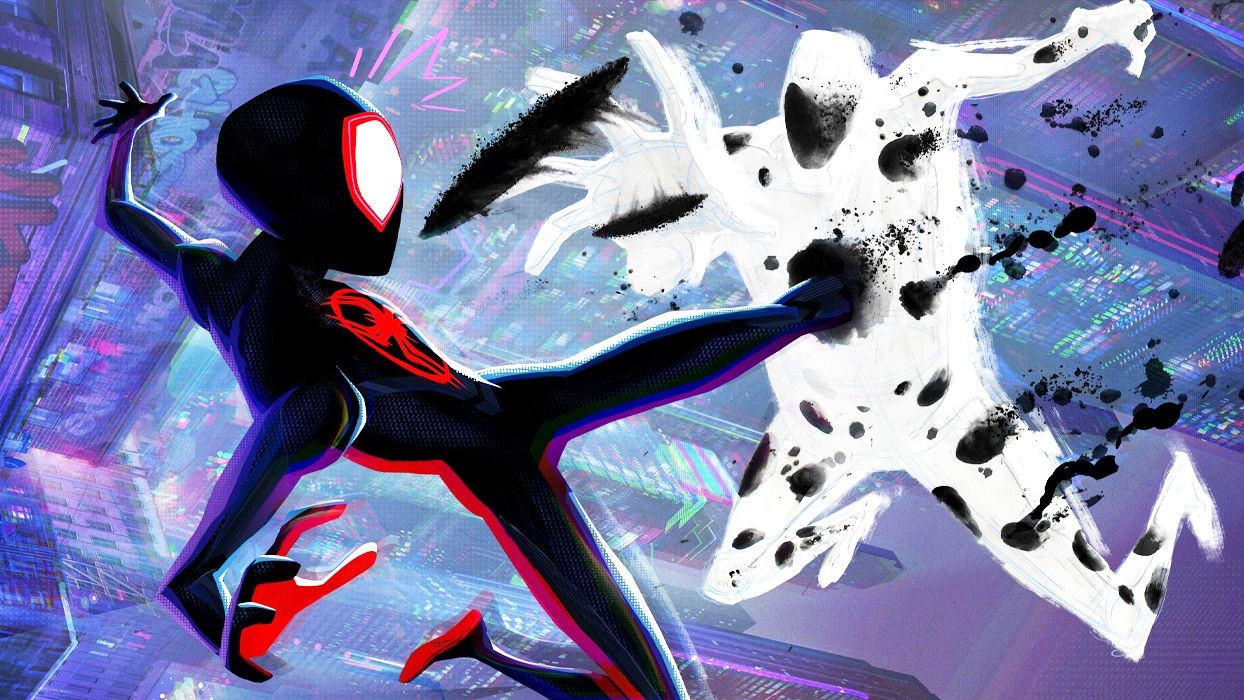
Beyond that, Miles’ primary focus throughout the film is stopping the Spot, the man whom he initially dismissed as a villain of the week but comes to see as a worthy nemesis. In the Spot, I see the personification of procrastination, the consequences of Miles perhaps not taking his job seriously enough, the realization that maybe he’s been a bit of a bully in addition to a hero and therefore created some of his own problems. Ironically, the Spot’s desperate need to be taken seriously is reflected in Miles’ desire to become a respected member of the Spider Society. He was so excited to “[be] invited to HQ,” happily introducing himself to everyone in sight, trying to make a good first impression on Miguel, only to be dismissed as a nuisance, a kid and ultimately a dreaded anomaly. Even the new suit he was so proud of designing is constantly made fun of (“what’s he bleeding from his armpits?”). I don’t think this parallel is a coincidence, and it’s my theory that this humbling will give Miles the perspective to understand and reason with the Spot.
As for Miles’ relationship with Miguel, the secondary antagonist, I thought it was interesting how similar yet distinct it was to Empire. In ESB, Vader’s relentless pursuit of Luke drives the entire film, so when the two finally meet it feels like the long awaited showdown, the culmination of this great evil scheme. With ATSV, Miguel’s done everything possible to isolate Miles (especially from Gwen) while the latter desperately wants to include himself. So when Miles finally gets into HQ, it’s that same sense of culminated tension but now it’s because the antagonist’s carefully laid plan has unraveled, and we’re about to see just how unstable Miguel is when things don’t go according to plan. It’s a real achievement to make Gwen’s timid introduction (“Miguel O’Hara, meet Miles Morales”) so much more foreboding than it has any right to be at face value.
Perhaps even more impressive is writing an exchange as genuinely impactful as “I am your father” without feeling forced or satirical. It’s up for debate but I’d say “you’re the original anomaly” qualifies, as I was genuinely surprised by the reveal, yet it made total sense and would similarly unbalance our protagonist as the line in Empire. I appreciate how it wasn’t even necessarily framed as some big shocking moment, or lingered on, as with most attempts to equal that iconic scene from Empire, but rather said in the heat of battle with the specific intent of shattering Miles’ confidence and sense of identity. (“At the end of the day, I’m Spider-Man and no one can take that away from me.”) Miguel immediately follows it up with every other demoralizing comment he can think to make, calling Miles “a mistake,” blaming him for Peter’s death, the plight of Earth 42, etc. Basically, he was just trying to break Miles’ spirit, using selective truths, exaggerations and lies of omission to do it, which made the line feel natural and not meta. My heart breaks every time when Miles yells back “no, you’re lying, I’m Spider-Man!” because we know how much that mantle means to him. Though of course, it’s actually the true extent of Gwen and Peter B’s betrayal which ultimately destroys his composure.
When Miles gets “home” and has that triumphant conversation with “his” mom on Earth 42, I find myself wanting to fist-pump every single time. The lines he says (“I let ’em have it mom, I beat ’em all […] and now, I’m not afraid of anything”) could come off as so corny or self-congratulatory had it been a lame, badly realized character like Rey Palpatine saying them. Here, it feels so earned, this poor high school sophomore (junior?) who just wanted to be accepted, took on the proverbial world and won. Miles Morales, the best Spider-Man of them all, because he outsmarted every other pretender to the title all at once and stayed true to the morals of the mask. It’s honestly one of the most badass hero monologues ever, though sadly his own parents never got to hear it, in keeping with the theme of parents only seeing/assuming the worst of their children (but, to their credit, loving them anyway a few hiccups aside).
When we leave Miles, in the clutches of an even grizzlier version of his Uncle Aaron and his darker self, I think there’s meant to be a silver lining in the bleak fog of war. Namely, this will finally communicate to him (and the audience) how profound of an impact Jeff had on his life as well as the city itself. He may have to confront the true extent/possibility of his uncle’s evil in comparison, that if left to his own devices Aaron would pass on the worst of himself to Miles. But even then, the more wicked his Earth 42 counterparts are, the more it justifies Miles getting bit by the spider. Had the spider remained to bite his shadow-self, it would’ve just created an even more powerful criminal. Only by biting Earth 1610 Miles, who has Jeff to keep him on the straight and narrow, could a worthy hero prosper. Miles may be an anomaly, but no one except Miguel ever said that had to be a bad thing…
 the Carbon Freeze
Excellant review of the film. I know this ia a work of love. You like this film so much that you saw it seven times, three times with me. I am very happy for you that you found a movie that you liked this much.
LikeLike
Sorry to learn Akira Toriyama has died. It seems Dragon Ball was a big influence on the Spider-Verse films and so much more…
LikeLike