
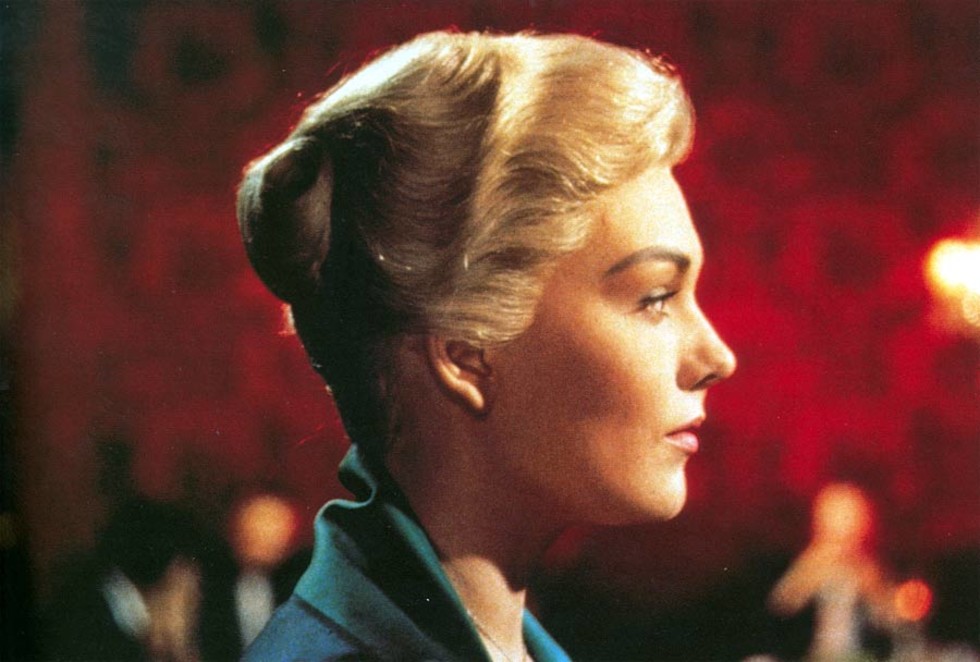
We never meet the real Madeleine at all in the movie so, like Scottie, we only get to see an idealized fantasy. Madeleine as played by Judy is elegant, regal, and refined. She’s alluring and sensual without being licentious or otherwise undignified. She’s mysterious and worthy of examination, especially to an obsessed detective. She’s a unique mixture of the distant femme fatale as well as the adorable damsel in distress. In short, Madeleine Elster is the ultimate dream girl for most men, Scottie included.
Where Scottie is in many ways the everyman for male viewers to project their experiences onto, and Judy fulfills the same role for women, I believe Madeleine is more of a larger than life metaphor for longing. She is the fantasy of sex and fulfillment which our modern society bombards us with 24/7. This image is fed to us through advertisements, melodramatic love songs and romantic films, giving people exaggerated expectations of what erotic desire is actually like. Women are told they’re not beautiful unless they buy XYZ makeup or ABC designer clothes. Men are told the reason they’re having problems getting women is they don’t drive the right car or drink the right beer, and if they would just buy more products, suddenly they’d be irresistible. It’s these warped perceptions that exacerbate a lot of the insecurity and dysfunction in people today. This is represented in the film by Madeleine’s image, a carefully curated illusion by Gavin (the media in this allegory) destroying Scottie and Judy’s lives.
How Much of Madeleine is Real?
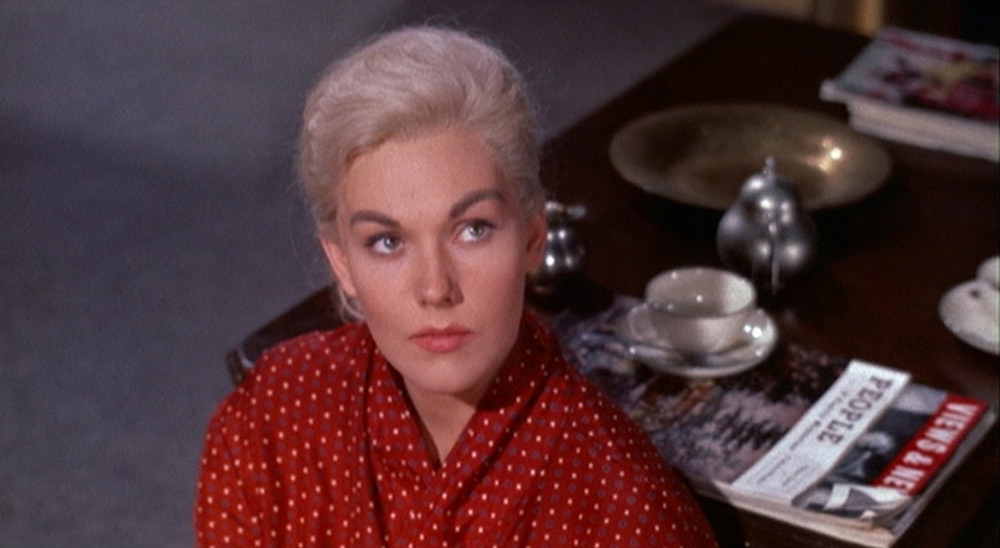
Part of the fun of Madeleine’s character on rewatches is determining how much of her dialogue and mannerisms were Gavin’s instructions and how much was Judy improvising and/or fighting back attraction for Scottie. On some level I think Gavin intended her to be a woman Scottie would love to follow around and learn more about. At the same time though, I don’t believe Gavin intended for Scottie to actually fall in love and get so tortured by the experience. It’s obvious some kind of meeting between damsel and detective was planned, as Gavin would want him to see that these travels of hers were done unconsciously. The only surefire way to communicate as much would be for them to talk face to face. Later, after the two meet up when Madeleine delivers the letter and they go to the Sequoias, Scottie is allowed to witness her going into an apparent fit of apparition. Finally, on the beach and back in his apartment Scottie hears about Madeleine’s dreams and supposed prophecy of doom.
At the same time, it should be noted that while hearing Madeleine describe her own condition might aid in the plan, Gavin could also have achieved his goal of murder if Scottie had still been trailing her from afar while she visited the mission on her own. Logic dictates this would be much simpler than seemingly predicting Scottie’s every move in a complicated scenario where the two interact face to face. Indeed, having Scottie meet Madeleine seems pointlessly cruel and potentially problematic. What if Judy flubs a line, gets caught in a lie or breaks character? What if Scottie refused to let her go into the church after their kiss, or called the cops for backup at any point? What if Scottie rose above the call of duty and staked out the Elster home in case Madeleine had another fit of apparition at night? (He might have seen the real Madeleine, or Gavin and Judy together out of character in that scenario.)
So, all of these meetings could have been part of a carefully laid out scheme by Gavin, or, my theory is it might have been improvisation when Scottie acted in a way that was unexpected. It would be far more wise to assume Scottie would have taken Madeleine to a hospital or back to her home after the first suicide attempt in the bay. Having the two get involved that night seems very needlessly risky for Gavin and with no apparent benefit to his plan. Scottie was already convinced that Madeleine knew nothing of Carlotta and was therefore in some sort of trance during his second meeting with Gavin (before talking with Madeleine herself). Nothing Madeleine says in Scottie’s apartment is new information, it’s just getting it from the horse’s mouth and reaffirming a narrative he’d already wholeheartedly believed in.
This is why I believe the events in Scottie’s apartment were unforeseen and therefore Judy was improvising (quite well, I might add) while trying to remain in-character. This is the reason she insists on pinning up her hair so quickly—to feel like Madeleine—and why she leaves at the first opportunity. After all, the longer she remains the greater the risk she gives herself away. So, the Sequoia forest, beach and second meeting at Scottie’s apartment represent Judy and Gavin trying to work the shifting situation in their advantage. This then required a lot more improvising by Judy, and meant she now had to string this poor guy along for the plan to work–something she didn’t sign up for. This is why she says “it wasn’t supposed to happen this way—it shouldn’t have happened!” at the Spanish Mission. She did not originally intend to get emotionally involved, to make Scottie feel so personally invested in Madeleine’s plight, much less fall in love with him. The original plan was far more impersonal, where she just had to walk around dressed like someone else a few times.
I believe the moment Judy (as Madeleine) fell in love, and where her in-character improvisation got carried away, was when they kiss on the beach. If the ocean represents Gavin and his influence (more on this later), the splash from a wave in the background represents a snag in his plan as it came up against unforeseen circumstances. Judy was so wrapped up in the role of damsel in distress, so empowered by having a man fawn over her for once, that she acted without considering the consequences. Not to mention, in-character it makes sense for Madeleine to throw herself at Scottie in this scene of vulnerability and passion, so Judy got caught up in the moment and did just that. Like Scottie pulling her out of the bay, this willful and complete submission may have awakened some primal feminine role in her. I like to think having a man care for her, take such an interest in her, led the plain ordinary Judy feel like a truly desirable woman for the first (second maybe, including Gavin when he led her on) time in her life.

An Amalgamation of Two Conspirators
Why did the real Madeleine find herself the subject of a convoluted murder plot in the first place? Gavin either married the woman for her money outright, or he actually did love her once. If the latter, it means she displeased him somehow, perhaps when he reluctantly took over the shipbuilding businesses. If so, that means he used and then discarded a woman as it suited him, a perfect parallel of the Carlotta story. There’s not enough evidence to say, but I prefer to believe this was the case, as it mirrors Scottie’s arc and the Carlotta legacy. Assuming the real woman he married looked anything like Judy’s portrayal, this implies that even the picture perfect feminine ideal doesn’t stand up to scrutiny when held up close.
For Judy too, I strongly suspect she enjoyed playing the part and escaping her own miserable, dull life. She probably got closer to Scottie and enjoyed every second of it for the same reason–being Madeleine was a lot more fun and interesting. That’s also why she was too weak to defend her old appearance and identity when Scottie came knocking after Madeleine’s death; on some level she wanted a chance to step into the role again. After all, Madeleine is everything plain-jane Judy is not. While Judy’s distressed by it, and largely motivated by guilt towards Scottie, she didn’t exactly take a lot of convincing.
Madeleine’s first line onscreen is a meta question to the audience: “what am I doing here?” because her actions are not as they seem. We’re meant to be skeptical of her motivation where Scottie is too blinded by lust. Then, her final lines on the tower are the only time she has ever been truthful to Scottie, where she answers her own opening question at last.
 the Carbon Freeze
Another comment about the “what if Vera Miles had played Madeleine” angle:
Kim Novak has stated that Hitchcock blamed her, in part, for the box office failure of Vertigo, stating: “you ruined the film!”
What did he mean by that? I believe he was referring to the way Novak personally interpreted and related to the character of Judy, the pseudo-Madeleine. She has described her understanding of Judy who never saw herself as an accomplice to murder, and who may not have realized the murder was going to take place.
I believe that Hitchcock’s view was quite different – – that Judy was a complete, knowing accomplice to the murder plot. In his view, she was a cold-blooded killer who nevertheless (and very oddly, almost perversely) fell in love (or lust) with Scottie.
That may be why Vera Miles would have been his first choice to play the part. One can totally envision her as being a cold-blooded killer with no moral compunctions about taking advantage of Scottie when he found her on the street.
Whereas Novak thought of Judy as being truly, deeply in love with Scottie as a kind of knight in shining armor, Hitchcock’s idea might have been that Judy was just using Scottie as a “sugar Daddy” and pretending to love him to protect herself.
In that case, the final tower scene might have played out very differently, with Judy realizing that her whole deception of Scottie had fallen through, and that she was likely to end up in jail or worse, now that Scottie had seen completely through her act. All of her explanations atop the tower would have come across as imaginative excuses, but nothing more than empty lies.
LikeLiked by 1 person
Thats fascinating to consider and I appreciate you adding another angle to this analysis Id never known! I prefer Judy as the damsel whos along for the ride and genuinely fell in love with Scottie–it makes the story so much more tragic and complex than just another femme fatale neonoir. I also think Hitch was scapegoating Kim and being a dick. If you dont like how your actor is performing the part, give better direction or fire them.
LikeLike
I agree with you, and feel that Kim Novak played a key role in making a good movie into a great movie.
As a thoughtful and sensitive and kind woman, Novak had some insights into the characters she played that I don’t believe Hitchcock could have had.
I’m suggesting that Hitchcock had a rather two-dimensional view of the female psyche. Novak brilliantly realized on some level that the movie would work better if she played Judy and Madeleine the way she did.
HItch, unfortunately, had no clue at the time, which is why he regretted not using Vera Miles for the role.
One wonders if, years later, Hitchcock might have eventually realized that Novak’s “rebellious” solution to the characters made it a much more fascinating film.
LikeLiked by 1 person
Im not sure but I hope so! He did not live to see the film’s rediscovery as a classic I dont think (As I recall that happened in the 90s or maybe late 80s) but based on what Ive read he always had a special place in his heart for it and considered it his most personal film–I think he knew on some level it was his best.
LikeLike
Wow its uncanny I was thinking exactly this and came across it!!!
LikeLike
Agree about Hitch being a “…k” by scapegoating Ms. Novak, and it seems he was also a jerk in dealing with some of his other late-career actresses – especially Tippi Hedren (not to mention Frenzy’s misogynistic objectifications).
As the director of Vertigo, he was 100% responsible. Could have reshot any scene he wanted to, with stricter instructions.
…but he didn’t. Perhaps he might have realized on some level (despite himself) that Ms. Novak’s take on the character might make the movie “work,” although not quite the way he’d imagined it when planning for Ms. Miles to play the part.
Quite possibly, Kim Novak couldn’t have forced herself to play the part in any other way, especially if she was a trained “method” actress and had to find herself in the character she was playing. Hitchcock made it clear that he hated working with method actors (e.g., Montgomery Clift), because he couldn’t control them 100%.
LikeLiked by 1 person
Here’s a puzzler to consider: What if Scottie had taken Madeleine back to Gavin’s apartment? Perhaps we can assume that the real Madeleine wouldn’t have been there (too risky), but if for some reason she was, the whole plot could have been revealed then and there.
Interesting question: Why does Scottie strip her nude? He could have wrapped her in blankets to keep her warm despite wearing damp undergarments, which would have gotten somewhat dryer during the long drive to his apt. It seems odd that she didn’t seem mind at all.
It also seems odd that she seems to have gone unconscious in the bay and to have remained unconscious on the way home and while being undressed. One would imagine that, at her age, she might have at least been groggy and partially awake.
LikeLiked by 1 person
If the movie has one “objective” flaw it’s definitely that sequence for sure. To me, thats a case where you just kinda have to go with it, dont think about it too hard, let the movie just do what it needs to for the story to work. As Ryan George of Pitch Meetings would say, “so the movie canhappen!”
To try to give an “in universe” answer though, I guess the point is to show that Scottie wanted an excuse to see Madeleine in all her glory, that his lust overtook him where Midge’s bra is just “a doohickey.” I guess it shows that even at this point, underneath his polite statesmanly asexual demeanor hes still a red blooded man. As for Judy, I guess we have to assume she really passed out because I genuinely dont think its possible to fake it the entire time a stranger is undressing you. So I guess it’s to show that she already feels “exposed” and therefore submissive to Scottie, while also such a good actress she can maintain the facade as Madeleine. Tho she still takes the first opportunity to bolt, probably out of embarrassment, discomfort and knowing every second she improvises shes endangering the plan.
Its definitely a bit of a clumsy plot development but considering how much of a stretch the rest of the plot is, I’ll allow it.
LikeLike