
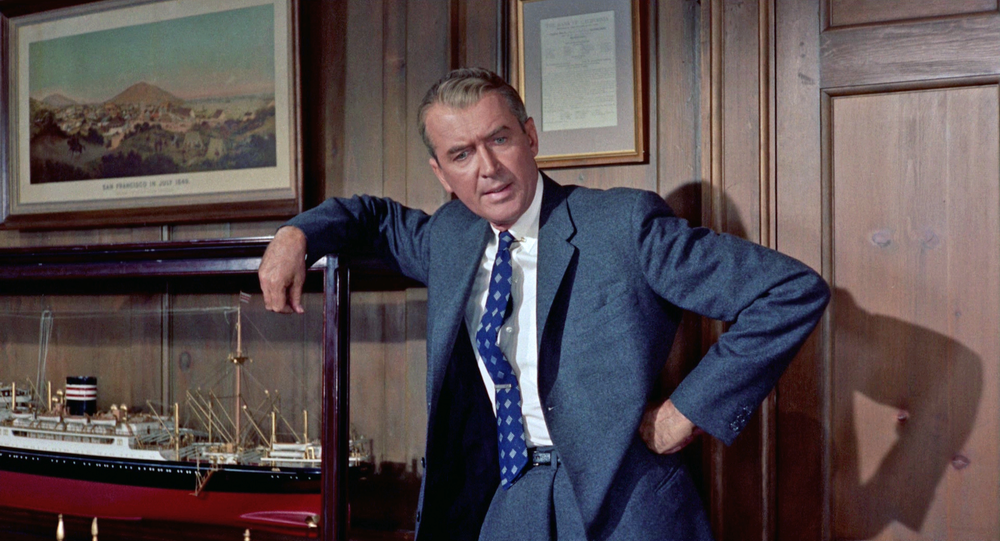
Overall, John “Scottie” Ferguson is one of cinema’s most complex and interesting antiheroes. This is a character who’s completely ensconced in a fantasy for almost the entire film, racked with guilt and insecurity, taking it out on a seemingly innocent woman. We aren’t given too much of his backstory, only just enough to piece together an impression, which I believe was a deliberate decision. This allows the audience to project a lot of our own memories of heartbreak and infatuation onto him and his situation. I really don’t think any actor except Jimmy Stewart could have pulled this off. His good guy, all-American image provided a perfect subversion of expectations. Our preconceived notions of the roles he’d always play softens our perception of Scottie more than he deserves. This means that when the character becomes an emotionally and financially abusive partner to Judy in the second half, we’re taken completely by surprise.
Stewart was criticized by some, including Hitchcock himself, for looking too old for the part. And, while the full head of gray hair might hamper our ability to buy that a beautiful 26 year old like Madeleine would like him, I think Scottie’s perceived age helped sell the character too. By looking older, it really gives the feeling that this is his last chance at love, and without Madeleine it’ll be too late to find someone else. This magnifies our belief in Scottie’s depression after she dies, and makes the ending 100x more defeating. Also, many of Scottie’s actions would seem more rude if coming from a younger man: the way he gets short with people including Midge, Gavin and the McKittrick hotel keeper for example. Finally, Scottie’s age may aid in Vertigo’s analogy of unequal relationships between the sexes; throughout history younger women were sought after by older men.

Scottie’s Sexuality
We never know Scottie at his best, because even at Midge’s apartment in the first scene, he’s had traumatizing nightmares and newly discovered acrophobia. Even beyond this debilitation, the guy seems somewhat stuffy and repressed, demonstrated by his weird non-relationship with Midge. To make sure we get the point, Hitchcock even has Scottie look at a bra as a “doohicky” and “a hobby” rather than an alluring invitation. Midge outright calls Scottie “the only man for [her,]” and he makes an uninspired comment about his availability without taking the initiative—even choosing to change the subject and offering to go home. All of these cues Hitchcock uses are deliberate, showing us that Scottie is almost completely asexual, even with a willing and decently attractive woman right in front of him.
It’s unclear whether Scottie just never met the right girl, or the right circumstances, but his sexual drive is seemingly nonexistent. Of course, the whole point of the movie is that there is in fact a deep and powerful drive within him just waiting to be awakened by the right woman. Once ignited, this passion will engulf himself and everyone around him in one of the most destructive romances the cinema has to offer. In hindsight, Scottie claiming in the opening scene that tomorrow he will be “a free man,” (after losing his corset,) is ironic because that is when he will also see Madeleine for the first time. From that moment on, all his thoughts and actions will revolve around her until the final frame of the movie. She becomes his center of gravity, especially during the “detective sequences,” guiding him from one location to the next as the Earth dominates the Moon.
It’s undeniable that Scottie took Gavin’s assignment because he thought Madeleine was beautiful and didn’t mind having an excuse to look at her all day. But a pretty face alone does not explain this obsessive fixation on her as we see throughout the film–that’s mostly left up to the viewer to fill in. I think part of the reason why Scottie imprints on Madeleine so deeply is because she’s an unsolvable puzzle, which as a detective must be intriguing to him. That, and saving her from the bay probably made Scottie feel powerful, important and like a man again especially after feeling responsible for his police colleague’s death. Traditionally, men would be the hunters and protectors of the tribe, guarding their women from danger. In our modern lives this once essential role is more or less obsolete (or at least obfuscated and less carnally satisfying for all involved), so saving Madeleine could have tapped into a primal masculine role that most men only experience once or twice if at all anymore.
Scottie’s Morality
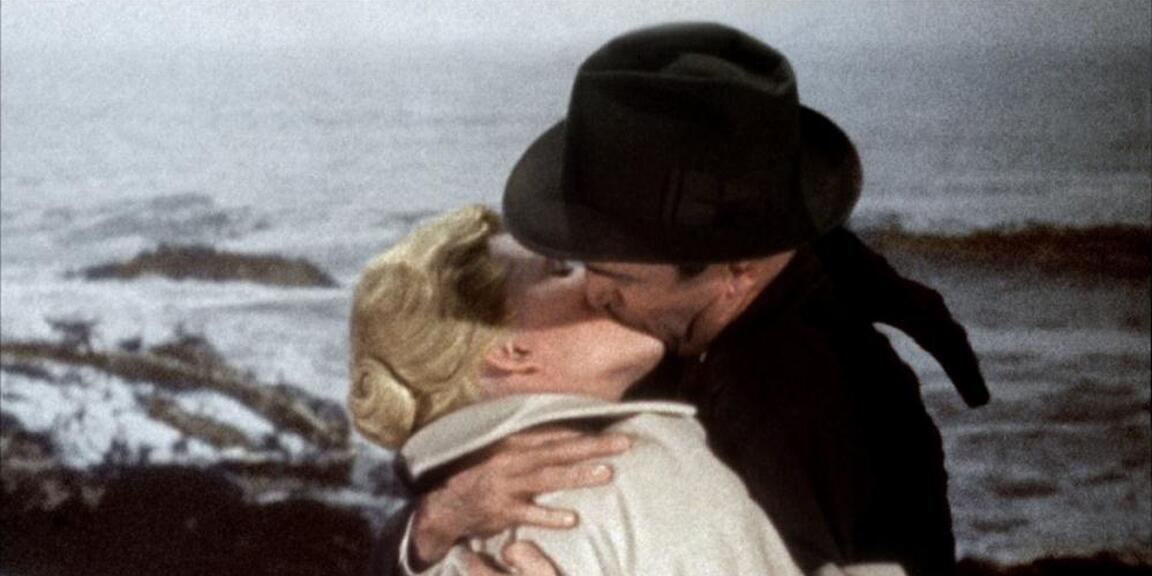
Scottie’s a decent guy as evidenced by several moments in the film. Firstly, he agreed to help Gavin out in the first place by watching over Madeleine. Scottie had no obligation to do so, especially considering his recent troubles, their obviously dormant friendship as well as the enormous cost in time such a project would entail. A second point in Scottie’s favor is how he saves Madeleine’s life and takes genuine personal interest in helping her overcome these fits of apparition after the fact. This is rising above the call of duty Gavin placed in him, which was merely to report where she goes so he (Gavin) can fully explain the situation to a doctor. Technically speaking, after the second meeting with Gavin where Scottie describes Madeleine’s routine, his work is done and he is under no moral or professional obligation to continue. Third, Scottie keeps Midge at arms length but does seem to enjoy her company and they have a good, playful back and forth. He doesn’t appear to be stringing her along as he plays the field (“aren’t you ever gonna get married?”), and he doesn’t expect her to wait around for him either. It’s not Scottie’s fault he doesn’t reciprocate her feelings, and for his part he seems to be totally unaware how strong her attraction is. (He even assumes Midge’s distorted picture of Carlotta is a joke rather than the romantic overture she intended it to be. )
All that said, there is a darker side to Scottie as well. The way he handles Madeleine’s unconscious form after saving her from the bay was always an uncomfortable detail for me since my first viewing. He undressed his friend’s wife and took a vulnerable woman to his apartment rather than just call a medic or her husband. I don’t believe Scottie…did anything…but it was certainly inappropriate and weird. Also, after Madeleine’s death, as understandable and sad as his longing is, it’s nonetheless creepy watching him prowling back to all the locations she used to go, almost like a single-minded stalker. Scottie’s treatment of Judy is also monstrous from the very beginning, barging in and interrogating her, taking her on a date when he wasn’t totally interested (and for all he knew, neither was she), making her economically dependent on him and of course remaking her in the image of his dead ex. Call it love, or lust, or limerence but whatever it was, it turned the gentle, soft-spoken Scottie into an unsavory, aggressive figure.
One aspect that balances Scottie’s darkness and keeps him from becoming totally unlikable is that he’s just such a pitiful character as well. Scottie is the only one of three men who couldn’t make the jump between rooftops at the film’s introductory chase sequence, and our first look at the character has him helplessly clinging to a gutter for dear life. He spends the entire movie duped by a lie, unwittingly aiding in a murder and then reliving the dark legacy of Carlotta. Scottie’s two big heroic moments: saving Madeleine from the bay and solving the mystery of her recurring dream, were fake triumphs he was set up to have. His dream woman, as it turns out, only talked to him because she was put up to it by another man, almost like a sick practical joke.
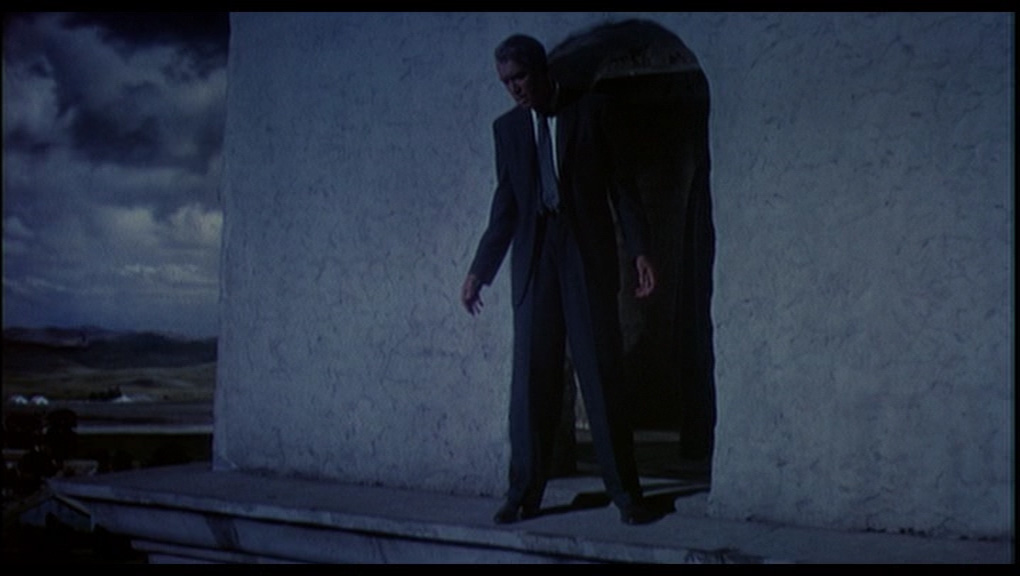
Scottie is very much a weak, impotent person at the mercy of forces he can’t control. In the second half, it’s not totally clear how much Judy actually still loves Scottie and how much of her motivation is guilt, fear or pity. His failure to climb the tower, to protect his woman, are direct and universal metaphors for impotency. It’s also significant how random and almost comical it is that after he does conquer the tower and his vertigo that a nun should appear and lead to Judy’s death. In what should have been his one moment of power in the film, breaking free from the fantasy and solving the murder, he’s rendered useless again by a hapless old crone of all people. It’s the ultimate insult, the final reminder of how weak and unlucky Scottie really is. In all these respects, he is the embodiment of mens’ greatest fears: looking weak or foolish (especially in front of women), feeling inadequate to protect and satisfy women as well as getting cuckolded. (Which is how he felt when he realized Judy was the agent of another man’s will all along.)

Scottie’s Revenge
At the climax of the story, Scottie becomes enraged at Judy’s deception. He has a right to be angry—she’s an accomplice to murder and her actions drove him into crippling depression for over a year. But on the other hand, he still abused Judy during their entire relationship, forced her against her will to the tower, reliving her most traumatic memory. As a result, Scottie indirectly caused Judy’s death when he might simply have called the police. She was guilty of a crime but it was not Scottie’s moral or legal right to manhandle and emotionally torture anyone, and it’s worth noting Judy clearly regretted her actions and was trying to atone for them in her own misguided way by submitting to his desires.
Scottie lost sight of the fact that, while his dream girl never existed, he had something potentially better—a woman willing to do all that to herself in order to become his dream girl so he could be happy. Judy’s initial deception means that, in a sense, he never lost the love of his life at all. In fact, she obviously loved him as Madeleine and continues to do so now as Judy. The woman he’s with has seen him at his worst and willingly sacrificed her own identity to bring out his best again. The question becomes, why does that not register to Scottie? Why is his first thought to taunt and guilt her, making the same mistake twice by going back to the Spanish Mission? Why was he so dead-set on this elaborate revenge, even with time to reconsider during the long car ride? Was he truly so wrapped up on his own feelings of betrayal that he couldn’t put two and two together to realize Judy must love him as deeply as he loved Madeleine?
To answer these questions, I would say a lot of Scottie’s rage seems to come from the fact that Gavin had Judy too, that they were in cahoots and he was the stooge. This is somewhat hypocritical since for all Scottie knew he was doing the same thing to Gavin by kissing and declaring love for his (Gavin’s) wife, Madeleine. Scottie’s reaction to Judy’s true identity is not logical or moral because it wasn’t supposed to be. All he can think about is his damaged sense of manhood: that he was tricked by a woman, that he was played for a fool when he meant to be (and—while he doubts it now—succeeded in) sweeping Madeleine off her feet. It’s a blow to his ego. On some level Scottie must be wondering: if Judy actually loved him how could she put him through so much pain? How could she run off with Gavin over him?
This happens all the time, where we judge ourselves by our best intentions and others by the worst interpretation of their actions. If Scottie’s overwhelming infatuation with Madeleine was born out of playing the hero and solving the mystery of her dream, in a sense it’s only natural that the death of this perception would then cause his feelings to shift to equally impassioned retribution. It’s the same psychology of every man who’s been bitterly rejected or cheated on and thereafter violently lashed out at the object of their desire. (And this violence from spurned, jealous or inappropriately lustful men is, in turn, every woman’s greatest fear.)

Scottie’s Fate
When we leave Scottie, he is in perhaps the lowest position of any protagonist in the history of Golden Age Hollywood. He knows Gavin is guilty, but his only source of evidence is dead, and nobody else will recognize or care about the significance of the necklace. (How do we know it’s one of a kind? Couldn’t it be a fake?) He is now truly responsible for someone else’ death, as has been the source of his overwhelming guilt and depression from the first scene. This will certainly lead to an even worse mental breakdown. Scottie is in a very compromising situation—there will be a lot of questions about why he’s been caught with a similar looking woman who died in the same place and in the same manner—he may even be retroactively charged for Madeleine’s death. Certainly there will be gossip and slander that damage his credibility should he choose to accuse Gavin, let alone try to live a normal life after all this. He’s too old and too broken to ever have a real opportunity for romance again; any shot with Midge was lost just to get this far. He will never be the chief of police he always wanted to be. He basically has nothing he can do but follow after Judy—what else is there for him to live for?
Scottie’s first words on screen are an expression of pain, which will be his default state throughout the film. His final words are a rejection of Judy’s plea for love, finally acknowledging he can never bring back Madeleine or those feelings. I like to believe that Scottie eventually became a figure in another of those “many such stories” that Pop Leibel will tell for years to come: ”the small stuff, people you’ve never heard of.” And, like with Carlotta’s male abuser in the original tale, no one will even remember his name as they relays this tragic and bizarre urban legend. That will be the sad legacy of John Ferguson.
 the Carbon Freeze
Basically Scottie starts out as a seemingly decent man who is revealed in increasingly clear ways to be using the women his life instead of truly loving any of them. Midge is convenient friend who Scottie doesn’t really know, Madeleine becomes an object of romance and fulfillment for himself and a transformed Judy an attempt to recapture that. His efforts to recreate Madeleine in Judy betray his motives as true love offers freedom and works for the best for the other.
LikeLike
I agree with the vast majority of your essay about Scottie and appreciate how much thought you’ve put into it. I’d like to read it again and probe more into the depths of his character.
I just want to point out that it seems like Hitchcock provides a much more detailed background about Scottie than the original (Boileau and Narcejac) book “D’entre les Morts” did. For example, there is no “Midge” character in the book. Rather than a deep psychological examination of Scottie, the book’s story is more of classic crime story, focusing largely on the “Scottie” character’s attempt to function as a detective trying to figure out exactly what happened tragically to him, and how he was victimized.
This may be able to help us better understand the “dark side” of Scottie. In writing the Scottie character, Hitchcock may have thought of him mainly as a well-trained character who was trying to solve a crime in the second half of the movie.
As you’ve noted, Scottie doesn’t necessarily seem to be romantically interested in Judy from the moment he first meets. So, if romance isn’t motivating him to spend time with her, what might his main motivation be? I believe it’s possible that Scottie’s main motivation may be to determine whether this woman “Judy” could have somehow “been” or played the role of Madeleine.
In psychological assessment, one uses a “hypothesis testing” approach. That is, the psychologist uses early data to formulate certain hypotheses about the patient’s mental condition. With each of the patient’s responses, these hypotheses are either confirmed, disconfirmed, or modified in accordance with each new bit of information. Going through this process is how the clinician ultimately arrives at a diagnosis.
It’s possible that everything “Scottie” does in the second half of the film. He coldly (almost clinically) tests her hair, the way she looks in the dress, her demeanor, her way of speaking, etc. (and he gets a chance to see her naked, which makes it possible for him to compare physical attributes in detail. Each time he completes one of these steps, he comes closer and closer to “recreating” Madeleine. Finally, the last piece of evidence he gathers is the necklace, and he has at last identified his victimizer.
So, while Scottie tends to come across as unreasonable, misogynistic, and abusive, his behaviors may make a certain amount of “sense” if they are viewed strictly as the techniques that a master detective would use if he thinks he may have found a criminal or murder accomplice.
If one is angry at Scottie for being such a bully, it may be in part because we’ve come to the point of sympathizing with Judy and hoping that Scottie is truly falling in love with her – – but being forced to realize that he still carries a lingering suspicion that creates an ongoing distance between the two of them, despite whatever kind of romantic affair they’ve been having. In other words, we’re unconsciously angry when it begins to dawn on us (the viewers) that Scottie has only been “using” her to test out his hypothesis.
LikeLike